The Gold Coins Fire Eater Gave Pinocchio
The Adventures of PinocchioThe Gold Coins Fire Eater Gave Pinocchio are a gift meant to relieve a family’s real poverty, but they become the bait for a promise of wealth without work. Pinocchio initially intends to use the money for Geppetto and for his own education; instead, the Fox and the Cat redirect it into their Field of Wonders swindle. The coins’ short journey—from compassionate gift to imagined fortune, concealed possession, and theft—makes them a measure of the difference between generosity and exploitation, and between earning a livelihood and wishing money into existence.
A gift prompted by poverty
The coins enter the story after Pinocchio explains why Geppetto has no coat: he sold the only one he owned, patched and worn, to buy his son an A-B-C book. Fire Eater responds with pity and gives Pinocchio five gold pieces, asking him to take them to his father with his kind regards. The scene makes the money an act of unforced generosity, offered in response to a specific sacrifice rather than as payment for a service. Pinocchio leaves delighted, kissing the Marionettes in turn as he begins the journey home.
His first plan for the gift is strikingly practical, even though he dresses it in a child’s extravagant image. He tells the Fox that he will buy Geppetto a fine new coat, imagined as gold and silver with diamond buttons, and then buy an A-B-C book for himself. He also says that he wants to go to school and study hard. The coins therefore hold two connected hopes: to replace the coat Geppetto surrendered and to equip Pinocchio for the education that the sacrifice was meant to make possible. The fantasy of the jeweled coat gives his gratitude a comic flourish, but the intended uses are care for his father and a return to school.
The promise of multiplication
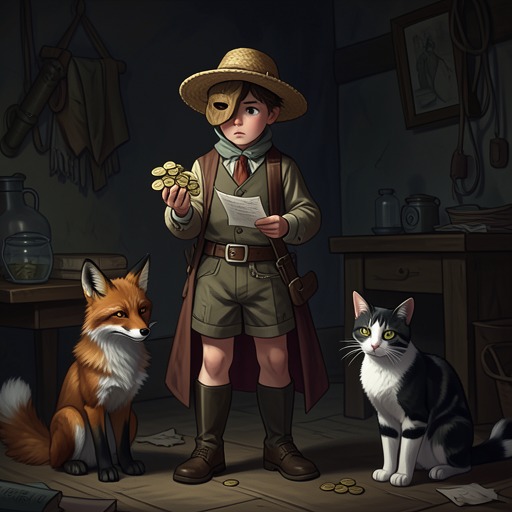
The Fox and the Cat turn Pinocchio’s gift into the basis of a confidence trick by changing what the coins seem to promise. The Fox describes the Field of Wonders outside the City of Simple Simons, where a buried gold piece supposedly sprouts overnight into a tree bearing coins. The offer is more seductive than simply spending the five pieces: it promises to enlarge them while sparing Pinocchio the labor of earning money. The Fox even calculates a supposed yield of twenty-five hundred new coins from five, presenting the fantastic return as though it followed from ordinary arithmetic.
Pinocchio accepts the explanation with wonder. Later, while traveling with the Fox to the field, he follows the planting instructions carefully: he digs a hole and buries the coins. When told to fetch water, he has no pail, so he takes off his shoe, fills it at a nearby brook, and uses it to sprinkle the earth over the hiding place. The small practical improvisation makes his participation concrete: he is not merely hearing a tale of wealth but performing the actions that the Fox claims will bring it about. Yet the careful covering of the money cannot protect it from the people who have led him there.
Concealment and loss
Before the planting, the coins have already made Pinocchio vulnerable in a different way. As he walks on after ignoring the Talking Cricket’s advice, he dismisses the possibility of danger from Assassins and imagines that he could frighten them off or run away. When two dark, sack-covered figures actually leap at him and demand his money or his life, he puts the gold under his tongue because he does not know where else to hide it. With the coins in his mouth, he cannot answer them; he tries to communicate through his head, hands, and body. The money that had represented a way to help Geppetto now prevents him from speaking when he is threatened.
At the Field of Wonders, the Fox and the Cat take advantage of Pinocchio’s absence. A parrot tells him that they returned while he was away in the city, dug up the four gold pieces he had buried, and ran off. The narration earlier presents Fire Eater’s gift as five pieces, while these later scenes refer to four; the story does not explain the difference. What it does show plainly is the result of the trick: Pinocchio digs furiously until the hole is as large as himself, but finds no money at all. He then goes to the courthouse to report the robbery. The promised tree of wealth leaves no fortune behind, only an empty hole and the discovery that the supposed investment was a theft.
From windfall to earned care
The loss gives the coins a pointed place in the story’s larger contrast between magical multiplication and honest work. The parrot’s explanation of the theft includes the lesson that money must be earned by work with hand or brain; the Field of Wonders has offered the opposite, a return detached from effort. Pinocchio’s credulity is not simply a failure to count correctly: he has been drawn away from his stated plans for Geppetto’s coat and his schooling by the hope that a small sum can become an enormous one overnight.
Later episodes provide a contrasting picture of what money can do when joined to labor and care. For more than five months, Pinocchio rises at dawn to draw water at Farmer John’s farm so that he can bring Geppetto warm milk. He also makes and sells baskets, builds a rolling chair for his father, studies by lamplight, and saves fifty pennies. When he learns that the Fairy is ill and has no money for food, he gives her those savings, setting aside the clothes he had hoped to buy. These later acts do not restore Fire Eater’s lost coins; they establish a different economy of value, in which work supports a parent and saved money can be freely given to someone in need.
The coins’ narrative importance thus rests not on their lasting material value but on the sequence of choices they expose. Fire Eater gives them in sympathy; Pinocchio initially directs them toward family and education; the Fox and the Cat recast them as a shortcut to riches; and the theft leaves him with no windfall. Their brief circulation contrasts a genuine gift with fraudulent promises of multiplication, while the story’s later scenes show Pinocchio practicing, through labor and generosity, the care his original plan had only imagined.